
Ignidyne · Flagship Product
Stop starting every cement design from a blank page.
CemWorks connects slurry design, spacer planning, laboratory testing, material traceability, approvals, and reporting in one workflow. Every completed job becomes searchable knowledge your team can reuse, so you re-test less, waste less, and protect margin.
The cost of starting over
Your lab already created valuable answers. CemWorks makes them reusable.
When designs, test results, and approvals live in separate spreadsheets, attachments, and inboxes, the business pays again and again for knowledge it already created. CemWorks organizes the complete lab workflow so historical work improves the next request instead of disappearing into an archive.
Reduce avoidable re-testing
Reuse relevant historical designs instead of designing and testing every job from scratch.
Cut waste and duplicated effort
Fewer trial formulations means less wasted cement, additive, mix-water, and technician time.
Preserve company-owned knowledge
Formulations, results, and approvals become an institutional asset, not scattered files and memory.
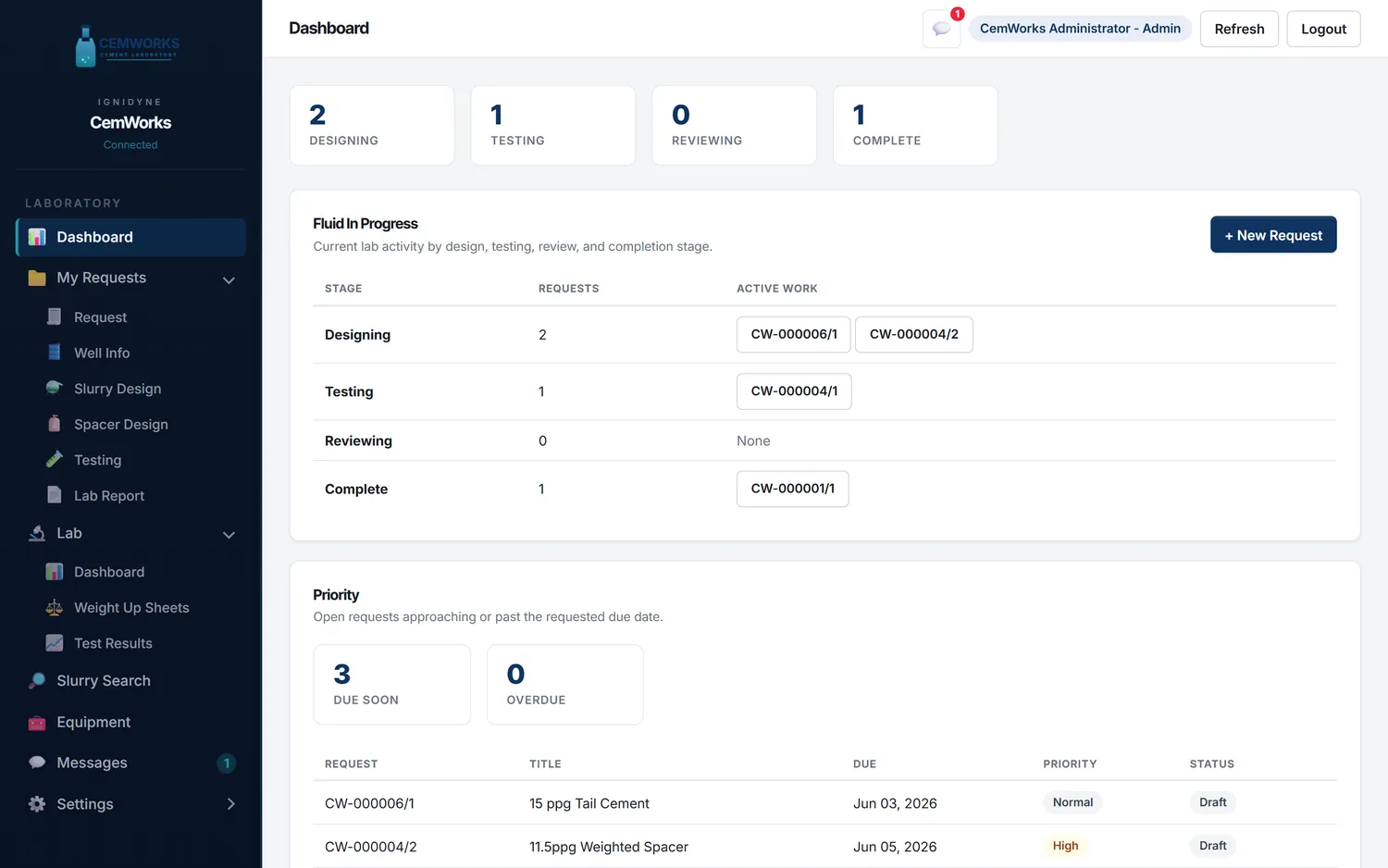
See work from request to approval
A visible lifecycle replaces status-chasing: what is designing, testing, in review, and complete.
Deliver consistent reports faster
Generate structured preliminary and final lab reports straight from request and test data.
Design from experience, not from zero.
Every completed cement job holds real design knowledge: well conditions, temperatures, target density, water requirement, blend and additive package, tracked lots, tests, and outcomes. CemWorks is built to harvest that history and use it as the foundation for AI-assisted slurry design, suggesting a more informed starting formulation and pointing the lab to the tests that still matter.
- Step 1 New job conditions
- Step 2 Retrieve comparable history
- Step 3 Suggest a starting formulation
- Step 4 Lab review and validation
- Step 5 Approved knowledge returns to history
How to read this: AI-assisted design is decision support with a qualified lab reviewer in control. It is designed to reduce avoidable re-testing from scratch, not to replace laboratory validation or approve a design automatically. Historical slurry search ships today; the recommendation engine is the next major capability.
Historical intelligence
Search the work you already proved.
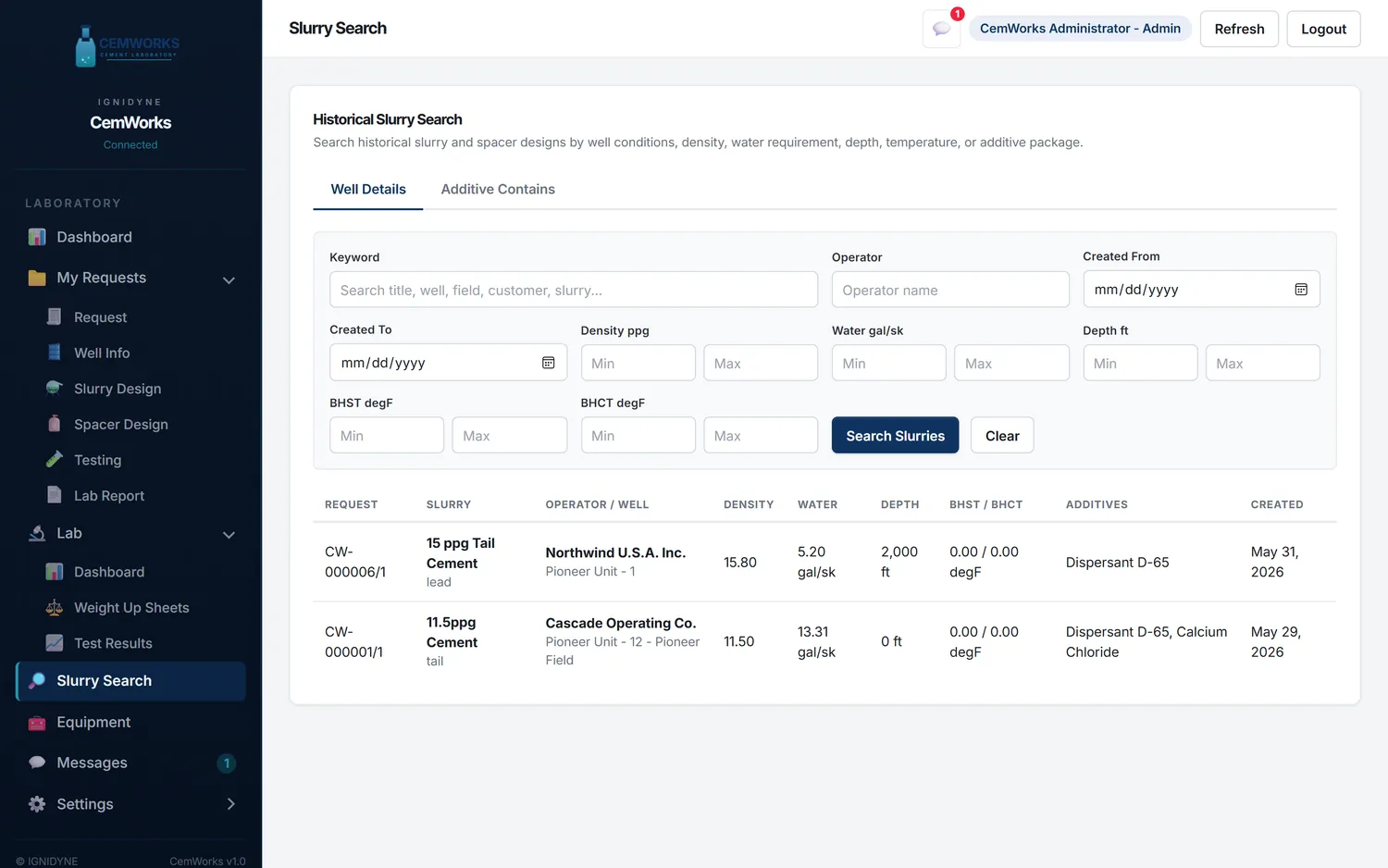
Find comparable prior designs by well conditions, density, water requirement, depth, temperature, or additive package. The history your team builds becomes the fastest way to start the next job, and the foundation the AI-assisted direction is built on.
- Density & water-requirement filters
- Depth & BHST / BHCT ranges
- Additive-package search
- Operator & well context
- Pass / fail outcomes preserved
- Reusable across future jobs
Design workspace
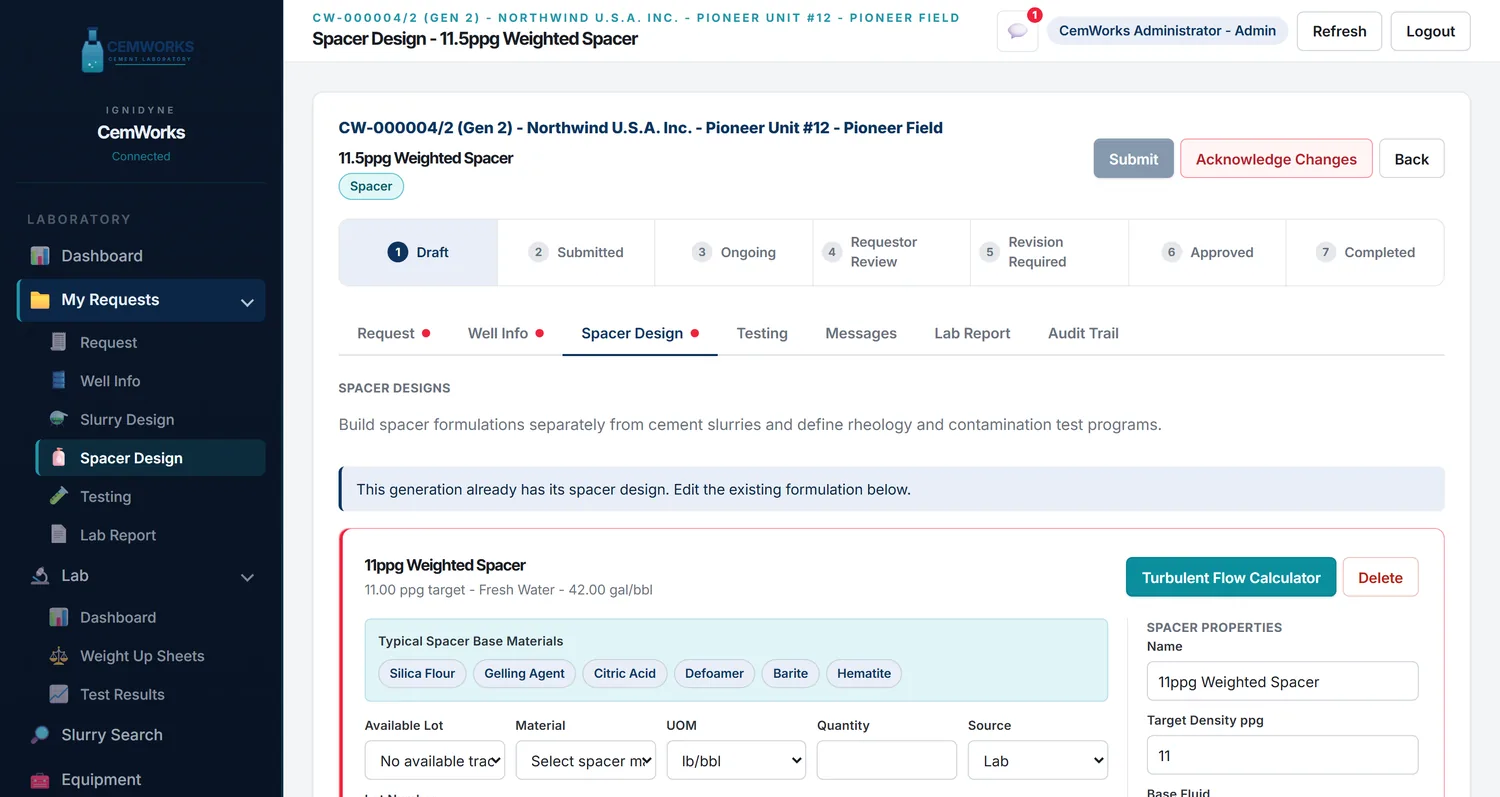
Structured slurry and spacer design, with the math built in.
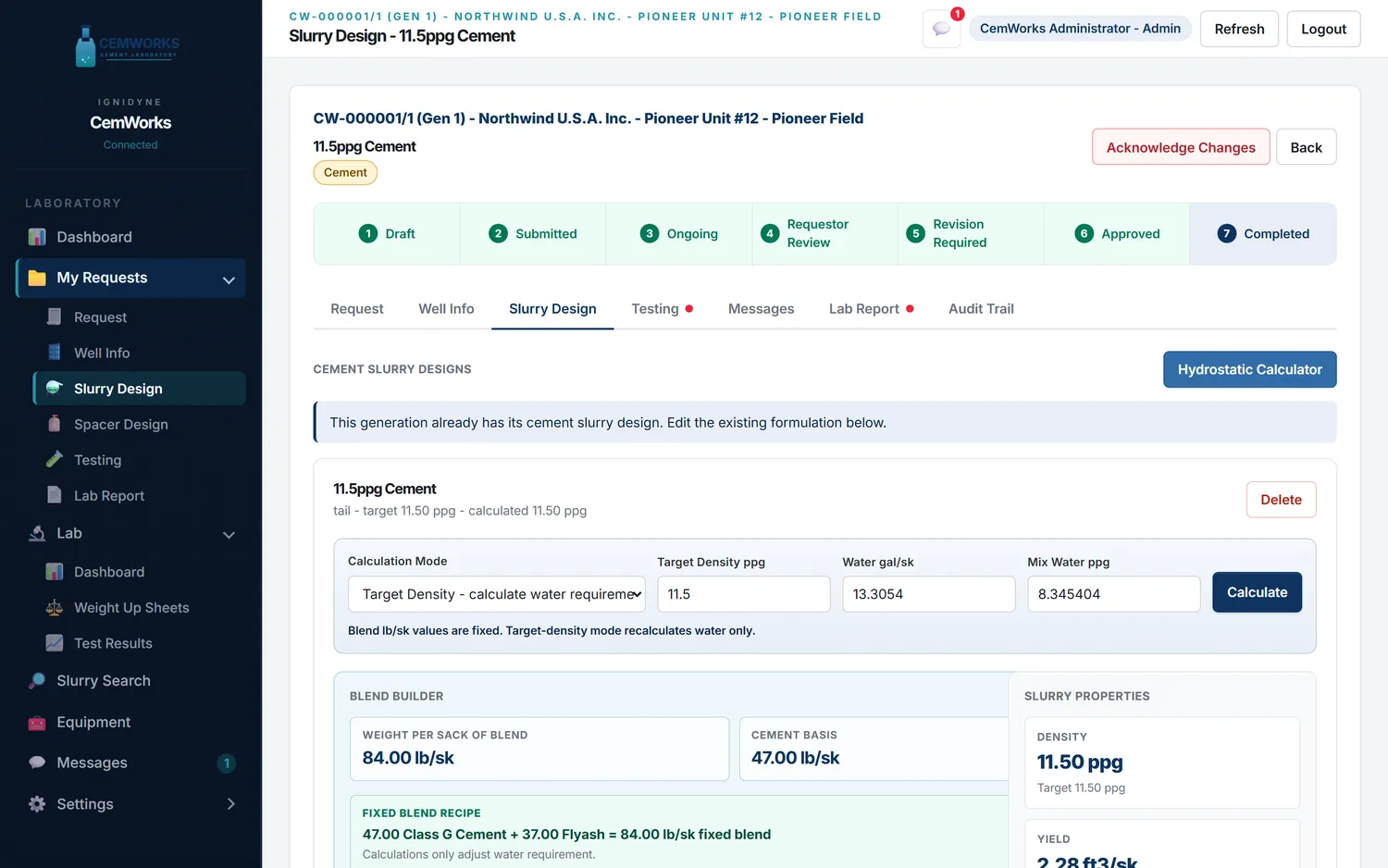
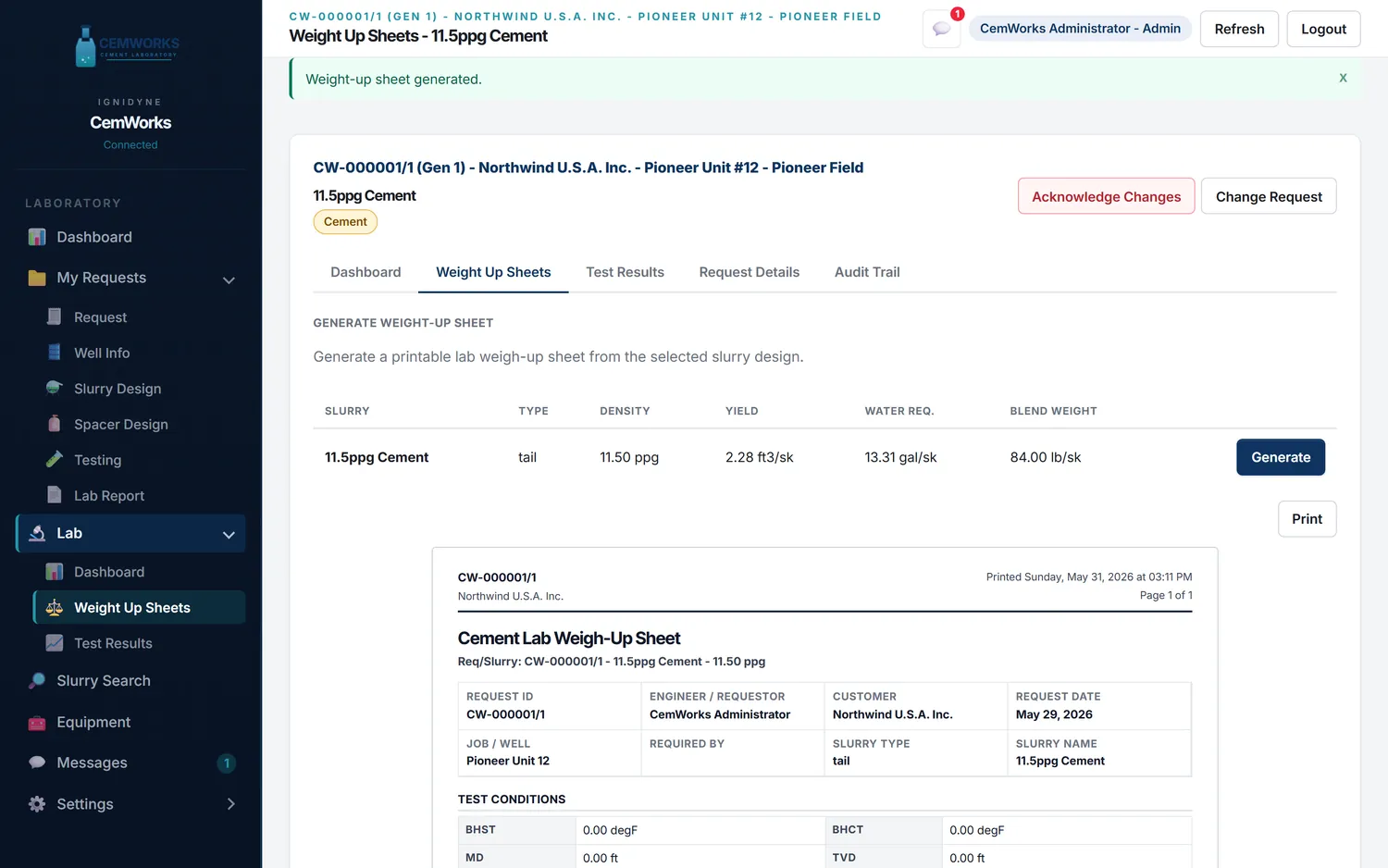
Build the blend and additive package, let the water-requirement solver hold your target density, and generate a lab weight-up sheet. Hydrostatic and turbulent-flow screens help sanity-check the design before testing. These are planning screens, not a substitute for job-specific hydraulic modeling.
- Cement slurry builder
- Automatic weight-up sheets
- Water-requirement solver for target density
- Hydrostatic screening
- Spacer design
- Turbulent-flow screening
- Structured test planning
Testing & reporting
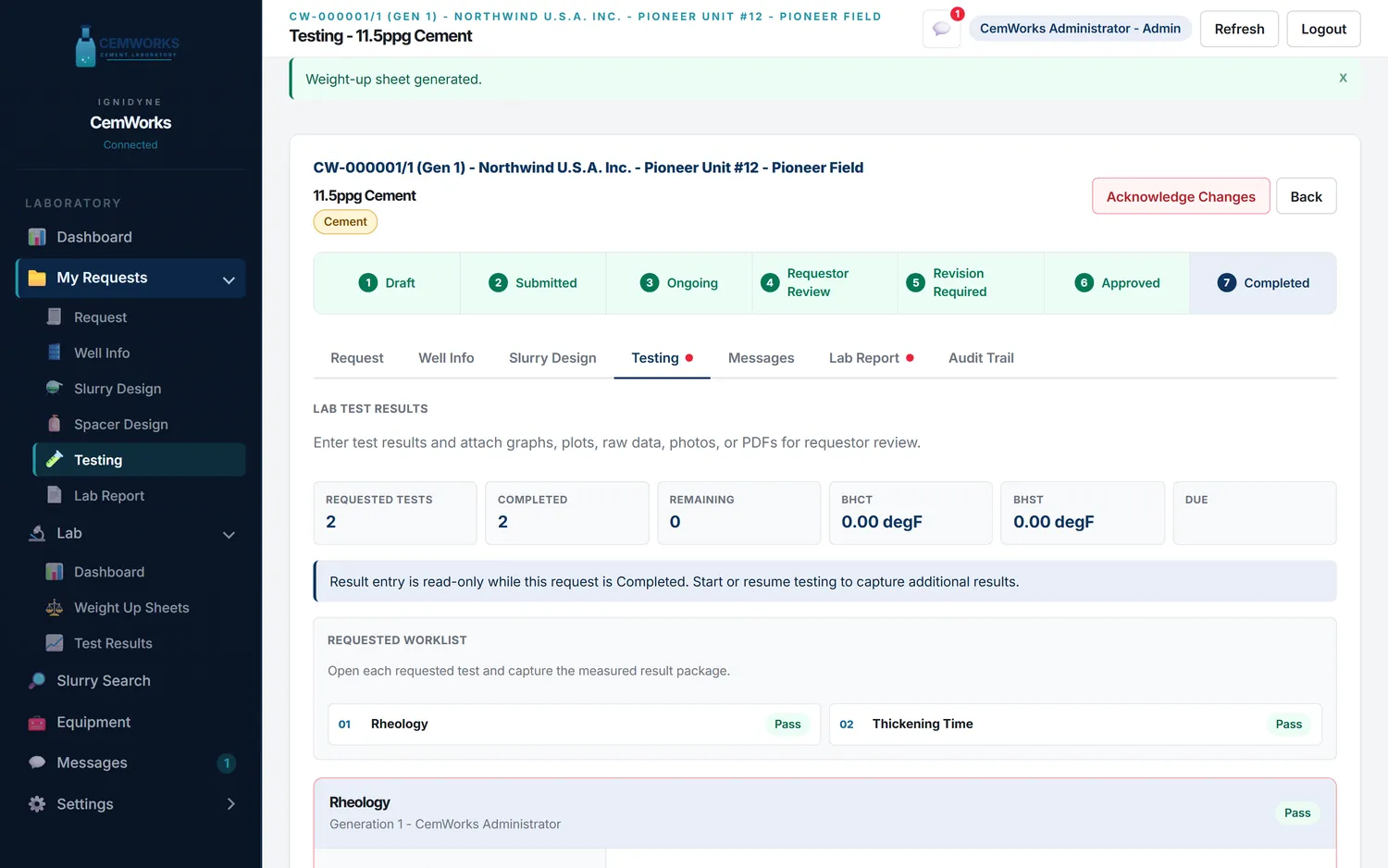
Keep the specification, the result, and the proof together.
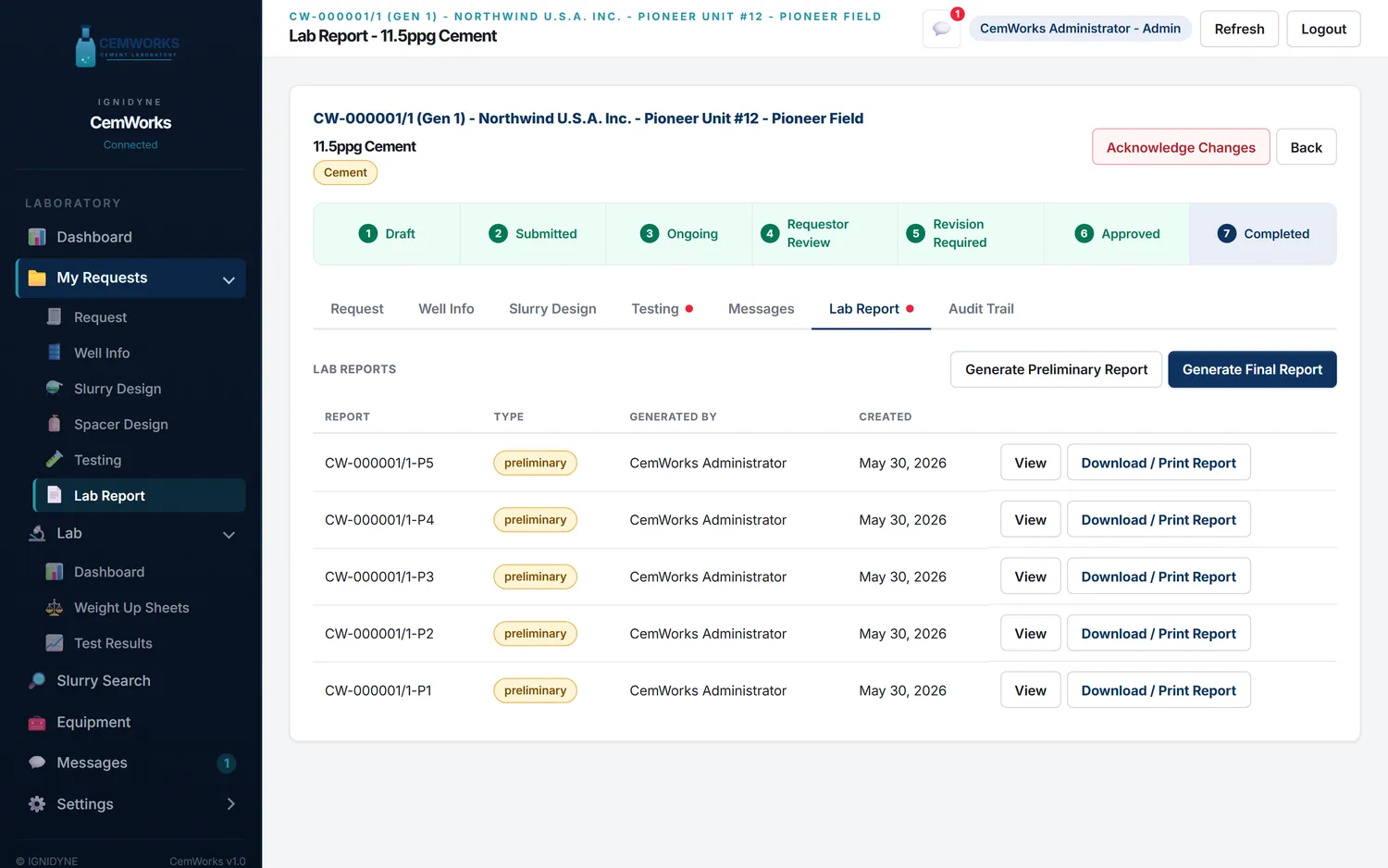
Requestors define the test program; the lab captures structured results for thickening time, UCA, rheology, fluid loss, and free fluid, with plots and raw data attached. Generate preliminary reports while testing is underway and controlled final reports once every test is complete.
- Requestor spec vs. result capture
- Plots, photos & raw-data attachments
- Preliminary & final reports
- Pass / fail per test
- Revision and approval loop
- Branded report output
Quality & traceability
Control built into the workflow.
Readiness checks, lot-level traceability, calibration, audit trail, and immutable completed records keep the lab accountable from intake to approval.
How CemWorks works
One controlled path from request to approved report.
- 01
Capture the request
Create a cement or spacer request with customer, well, priority, due date, density, and downhole conditions.
- 02
Add wellbore context
Search reference records, select the well, and record inner- and outer-pipe geometry with MD and TVD.
- 03
Build the design
Create the slurry or spacer formulation, choose tracked lots, and calculate the weight-up sheet.
- 04
Define the validation program
Specify the required cement tests, or the spacer rheology and contamination matrix.
- 05
Submit a complete package
CemWorks checks design, tests, well context, and tracked lots are ready before work reaches the lab.
- 06
Capture results and evidence
The lab enters structured results, attaches plots and raw data, and can issue a preliminary report.
- 07
Review, revise, or approve
The requestor reviews the package, asks for revisions, or approves. Reports and snapshots preserve the record.
- 08
Reuse the knowledge
Completed work becomes searchable history that strengthens the starting point for the next job.
Role-based operations
The right access for every part of the lab.
Requestor
Create requests, specify the test program, review results, and approve or ask for revisions.
Lab Technician
Work lab requests, capture structured results, attach evidence, and prepare reports.
Lab Supervisor
Oversee lab work, manage materials and equipment, and start a new generation after failed testing.
Administrator
Manage users, access, database health, and backups across the platform.
FAQ
Common questions
What is CemWorks?
An Ignidyne cement-laboratory operations and slurry-intelligence platform. It connects request intake, well conditions, slurry and spacer design, tracked chemical lots, testing, approvals, reports, and historical knowledge in one workflow.
Does AI replace laboratory testing?
No. The AI-assisted design direction is built to improve the starting point and help the lab focus validation where it adds value. Job-specific laboratory review and testing remain essential.
Does CemWorks support spacer design?
Yes. CemWorks includes a separate spacer workflow with base-fluid selection, material tracking, weight-up sheets, rheology temperature sweeps, contamination matrices, and turbulent-flow screening.
Can it track the chemical lots used in a formulation?
Yes. CemWorks tracks lot number, source, dates, quantities, location, status, and consumption, and prevents unavailable, depleted, or expired lots from moving forward.
Can it generate reports before all testing is complete?
Yes. CemWorks supports preliminary reports once partial results exist, and controlled final reports after all requested tests are completed.
How does CemWorks preserve accountability?
It records workflow transitions, formulation changes, test actions, revision history, report generation, approvals, and per-user change acknowledgement. Completed requests become read-only.
Make every lab job more valuable than the last.
See how CemWorks can help your team control the cement-lab workflow, reuse historical knowledge, and reduce avoidable re-testing from scratch.
Request a CemWorks demo